The Burning Stage #7 The Director’s Place
The writer writes the words to guide the actor in what to say.
The actor will decide how to say them to fit in with the character they are inhabiting.
The audience will decide why they are saying them.
So where does the Director fit into this process? If at all. Is the Director’s role any more than telling the actor where to stand and when to say the words for best effect?
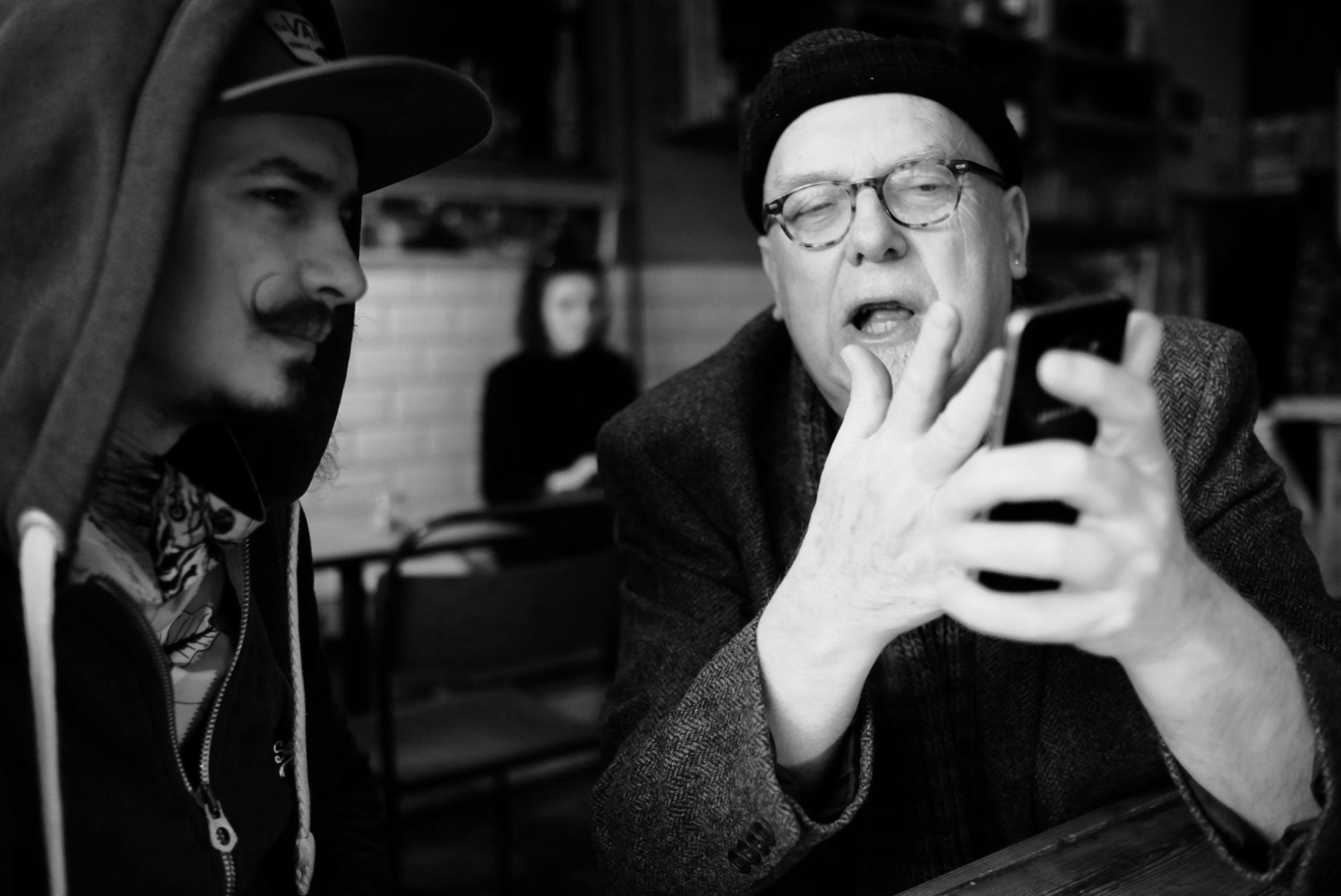
Peter John Cooper consults with Mirek Lucan on a knotty problem in the rehearsal for Life and Death and Everything in Between.
Up to now I have avoided talking about the role, if any, the Director has in the Burning Stage process. Directors are certainly not part of the Fiery Triangle of Actor, Writer and Audience. Yet we find a space for them somewhere in the process. I think
Let’s not forget that the idea of a Director as a specific part of the team is relatively recent in theatre practice. It is certainly post World War 2 where it came from Cinema and entered the theatre world via spectacular musicals. Before that, the role as described above would have been taken by the an actor manager, occasionally the writer but more often by a position known as a stage manager or producer.
So, for me, the Director’s role, as we understand it today, falls somewhere between being a mediator, an interpreter, an orchestral conductor, a choreographer and a football manager.
In the Theatre of Spectacle, the Director fulfills a vital role. There is just so much STUFF to be organised. Here, the actors can seem relegated to chess pieces moved around to fit with the lighting or music.
The Director has much more freedom in The Burning Stage. Instead of composing moves or subtle pieces of business, they help manifest the overall feel of the piece; taking from the words written to finding a pleasing overall effect while giving the actors freedom to move within them. The director provides a sort of meta existence for the drama. In other words, the director is concerned with the realisation of the piece. The director deals with the actors and the script whilst the actors deal with the the characters and the audience. And they form the bridge between those elements. “Let’s see what the writer is saying here. And let’s see how we can mediate that to the audience” The director helps shape the Atmosphere of a piece. They give the actors the space and time to experiment - to try things out and offer nudges towards the fruitful path to follow. They are looking at the ideas of the playwright and offering ways to deliver them to the audience. They are looking for pace and timing. How to adjust one to help the other. They will help build a framework for the actors to perform in.
That’s not to say that the Director does not occupy the “Stand here. Do that Now.” role some of the time but the principal function is to facilitate the actors in their endeavour to understand and create characters and their interactions. And they will encourage the actors to lock down performances at the end of a rehearsal process so that there is a way into the drama for the audience. But it is axiomatic that, in The Burning Stage, this is only the beginning of the adventure.
Quite often there is mediating role between the actors. And I don’t necessarily mean stopping actors from punching each other. (although that does occasionally happen) I mean forming the team ethos where the actors understand through their characters what the others are doing or intending, making sure they are following the same pathway. And acting as an arbitator when two such paths conflict. This results in a careful choreography of meaning and intention.
While the director should be able to stay slightly removed from the actors’ process, it goes without saying that they are able to observe the wellbeing of the actors and to consider the sensibilities of the audience.
Interpretation
One of the functions of the director is in interpreting a script. This used to come with a lot of kudos a few years ago and was seen as one of the key parts of the job. We quite often see a play billed as so and so’s reinterpretaion of Shakespeare. And, when Shakespeare was a more hallowed text, the reinterpretation was seen as more ground breaking. Peter Brook’s “Midsummer Night’s Dream” was indeed breathtakingly vivid when I saw it. Peter Hall’s version of the same play was just as striking in a different way. The point being that the director’s name was there on the posters, often in bigger type than those of the actors or even the playwright himself. The director had an authorial role in the process. But the idea of doing a “version” of Shakepeare was nothing new. In the eighteenth century audiences regarded as Shakespeare coarse and whole chunks were rewritten, Romeo and Juliet and King Lear were both given happy endings by Garrick. Shakespeare was seen as fair game for reinterpretion There is the famous case of Thomas Bowdler in Cymbeline subtituting “Trumpet” for “Strumpet” so that Imogen’s famous line now read: “She hath played the Trumpet in thy bed.” A striking if unhelpful image.
But my point is that in The Burning Stage, there is little to be gained by massive reinterpretation. There is so much more fun to be gained in making Shakepeare work with the intensity and and immediacy of an unplugged production, say. Neither is there room for a production reinvented merely for the personal satisfaction and whim of the director. That’s not to say that Shakepeare or any other playwright provides a hallowed text. Anything but; the words that Heminge and Condell passed down to us were working scripts and often misheard transcripts. I am not against cutting the text or setting the plays in alternate settings but I worry that the director starts with the view that Shakepeare is too difficult for their audience and needs to be made “more accessible”. I have done "The Tempest with a company of adults with learning difficulties, and while they may have found the actual words a bit impenetrable, they had no problems with the overall narrative of what Shakespeare was conveying. As I have said before, we often underestimate the ability of audiences to fill in the gaps.
And, on an entirely personal note, I believe that if there is some work to be carried out on the script, that should be between the writer and the director. There should be no need for the intervention of a third party. These two know what is wanted to be achieved and how to achieve it between them.
In the end, I think all theatre work is interpretation. That is exactly what I’ve been describing above. The interpretaion actually lies in the mere act of transmuting a written script into a real time event.
How Can a Director Help?
Pacing is central to how an actor approaches performance and here a director plays a useful guiding role. If we agree that silence is where the action happens (as Pinter might assert), then the actor needs to be able to achieve these silences. They need to be able to build a speech so that a silence for consideration or revelation becomes inevitable. That is the choreography and music of the words. It is dictatated by pace and speed. The Director can help the actor in their quest to WIN silences. They must find the pace of the words. Keeping the lines flowing. Sometimes breathing gently, sometimes moving sharply and quickly, each word and sentence treading on the heels of the one ahead. They need to be able accelerate through a speech or scene building in texture and nuance. Sometimes the actor will find this naturally. Sometimes they will need to be encouraged to hurry along or slow down. And as much as it is accelerando and ritardando it is also diminuendo and crescendo.
There are musical ideas that the director, like an orchestral conductor, can contribute. And these markings are there to help the listeners in the audience to appreciate the shape and music of the words.
Pace and speed are what help build the intensity of the drama towards climaxes. And building the overall structure and ascent of the journey. They can help identify the points at which the scene shifts - the Elbows of the play.
It is not that the actor is incapable of judging the weight and flow of the words they are speaking, but it can be reassuring to have a trusted outsider to observe how an audience might see it and understand the music. This also leads to unifying the style of the piece. Establishing the heartbeat and tempo that applies to the actors working together as one.
Thus:
The Director has a role as an intermediary between the three elements of The Burning Stage.
The director represents the audience to the actor.
And also represents the writer to the actor.
The greatest quality a director needs is clarity. To have a thorough understanding of the writer’s intentions and to be trusted by the actors that their understanding is sound.
Blocking
Blocking is just a term we use for getting people to stand somewhere useful on the stage. And where to come in and go out. It gives the actors a sense of organisation at the beginning of the process and sets out how the approach will be. It is the equivalent of a football manager setting up the team to play a 4-4-2 formation rather than a 3-5-1. It provides an initial field of operation and outlines various general strategies that can be deployed rather than having to micro manage each specific movement. It can dictate whether we play up the field in a high press or drop back and let the opposition come to us. It’s an arrangement that gives the actor a place of security to start from.
Writers are at their best when they write dialogue which implies time and space without having to hammer it home all the time. This is where the director can help transform the empty space of the stage by organising the movement within that space and finding the ways the characters exist within it.
Review
The Director will not be present at every performance. At some point in the process there must be a clear hand-over of responsibility to the actors. If the director stays too long there is a danger that the actors will start looking towards the director for validation, rather than listening to how the audience is reacting. With the director having a too great influence, the actors can begin to disagree with each other when they are not present. “I was told to stand here.” “No you weren’t. You’ve forgotten what the Director said last time.” And so on and so forth. The actors must inhabit the piece as their characters. They must hear the audience. If the preparation work in the rehearsal room has enabled them to understand their characters and the script thoroughly, they will be able to perform with complete assurance and awareness.
But it is inevitable that an intelligent and committed actor will begin to explore new avenues of interpretation within the performance. New insights are good but it depends on the other members of the cast understanding and accepting new ideas. An occasional review with the director will enable these to be explored and either incorporated or rejected in a way that will prevent things getting out of hand. Again, this provides security for the production.
The one thing that should be avoided is the temptation to micro-manage. Reviews should not be too frequent. A particular glitch at one performance does not necessarily mean that everything needs to be rerehearsed at depth. An occasional review, though, will tell the director whether things are drifting or that the audiences are missing an important point. Director’s Notes on a performance should be just that and not lengthy disquisitions on the philosophical implications of how an actor addressed a particular speech. Basically, that is because, at the end of a performance, an actor will be too mentally drained to absorb much beyond a glasss of something reviving. But if an actor feels they are not achieving some particular goal or the Director has gained some real insight from watching, then a rerehearsal of that point could be organised at a time when the actors have some energy to absorb it.
Things on Stage
Sometimes there is a need for a chair or table or a gun or an umbrella but generally these things just clutter up the space on the stage. Besides, actors can fall over things and break them. The director will brief the other members of the production team on how much or how little is required without cluttering up the production with useless junk. Actors love to have props to play with it. Give a mantelpiece a row of vases and trophies and someone will start picking them up and juggling with them.
A clever designer will know how to contribute the precise things that are needed in the décor for the interplay of the action without creating a distraction. But it must be remembered at all times that we are here to serve the audience and the drama. How simple can we make things so that audiences have a direct access to the work and are not just watching a spectacle?
Music and effects should be treated the same way. How precise can we be in placing these so that we can avoid turning the drama into spectacle? Those of us who are involved need to ask: “Are the audience being forced into a certain emotional response?” Is any music becoming intrusive so that it forms a barrier between actor and audience?
Light effects and projection are often over used because directors have watched too many films and believe the audience will insist on car chases and musical scores as they are easily bored. This director believes the people in the audience are not bright enough to make up their own minds as to how to watch the drama. It is true that many people will be unfamiliar with the dramatic art but that doesn’t mean they cannot understand and appreciate a form of drama that is open and unplugged. The key is to remember that audiences have imaginations and love being challenged to use them.