The Burning Stage - #4 The Actor
The Actor
I was never very good as an actor. I was too keen on performing; too easily seduced by the audience’s laughter. I enjoyed being on stage but never really felt the deep emotional truth. I enjoyed dressing up and pretending to be someone else. Yes, I know that’s starting point for any actor but I recognise that there is another level of skill that I never had.
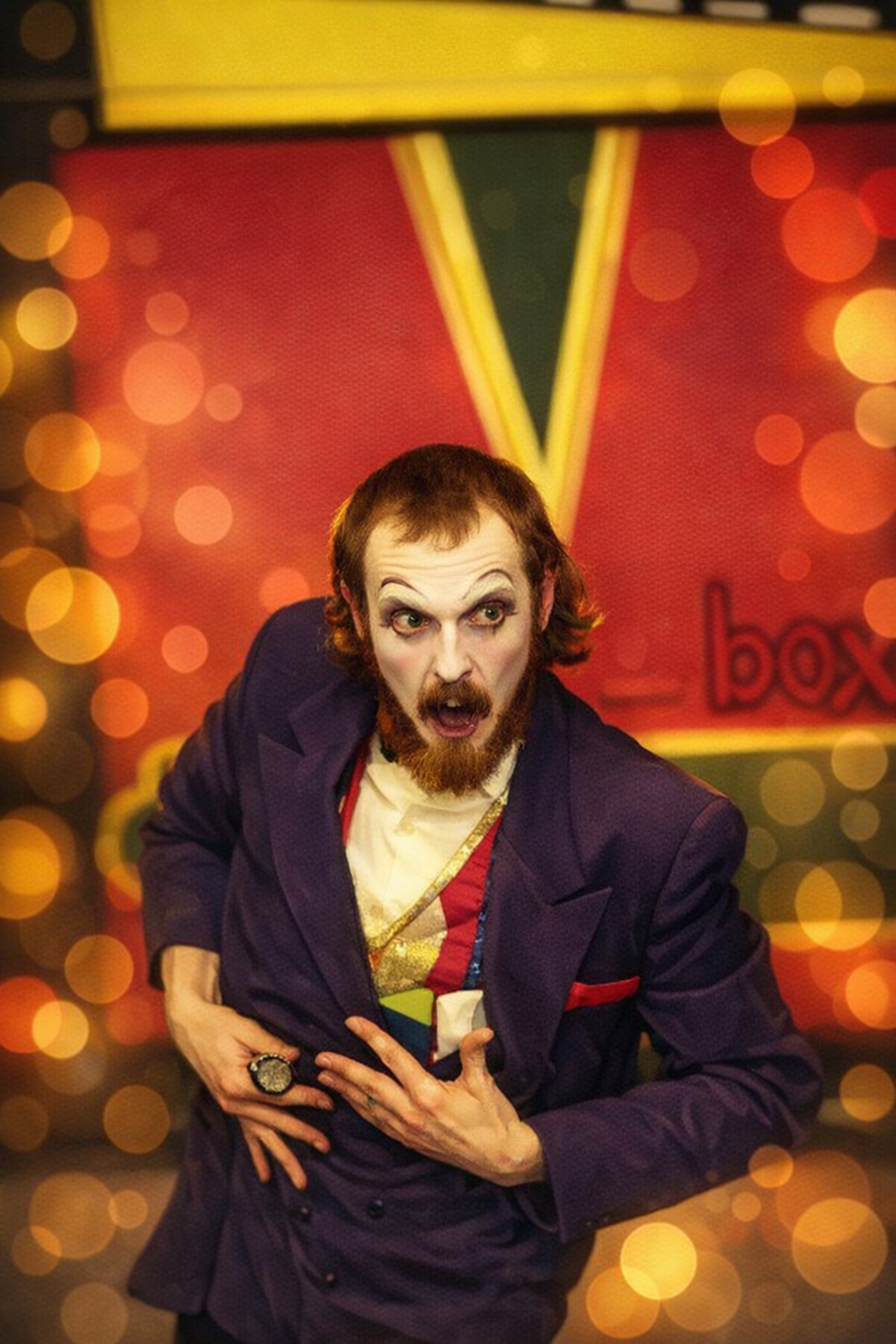
Performing not acting. Attic Theatre 1976. Photo by Judy Blake but I sharpened up a bit with AI because, well, you know, fifty years.
Another time, I was playing an unnamed courtier in a production of Hamlet in Basingstoke. I was given a line that Osric usually says “Young Fortinbras, with conquest come from Poland,To th’ ambassadors of England gives this warlike volley.”
I found myself alone in the greenroom with the instruction to dab a spot of Kensington Gore on my face just before I entered so that it looked as though I had been the victim of the English gunfire. Just a nick, you know. Sadly, with time on my hands I got rather carried away and one dab led to another. And another. As it does. My entrance, when it came at last, stepping over the dying Hamlet and dripping with great gouts of gore was greeted with gales of laughter. I was never required to act there again.
It increases my respect for that craft and those who know when enough is enough and who continue to hone their craft throughout their career. So I’m not going to insult you by telling you how to act. Even if you’ve never been on stage before. So I’ll talk about acting from my point of view as a director and a writer.
What impresses me as a director is the hard work, the commitment, the willingness to listen and learn that an actor brings to the process. I don’t really care where you are in your career or whether you earn money at it or not.
On the surface, the real skill is how convincing an actor can be. As Stanislavski wrote, the actor should always be seeking the truth in their character. Yes, but that’s not the whole of it. Maybe it’s also something to do with the relationship with the writer. The writer maps out the paths through the play. The actor lets the writer guide them through all the twists and turns so that they feel justifed when path gets them to some resolution at the conclusion. I suppose I say that as a writer. Or, perhaps it’s to do with the understanding of the way the audience apprehends what your doing. And I guess that’s me being a director again.
Now you, of course, as an actor, know all this stuff but I’m repeating it here as a way of focusing on the particular idea of the Burning Stage.
Performing is not Acting
The Burning Stage is the place for a story. The writer will provide the words to the story. They will construct the characters and the situations. But you, the actor, will carry that story to the audience. You are the mediator of the story. You are the Higgs Boson giving the story reality and weight.
It is worth remembering that the audience does not know what you know. They come with a limited expectation and it is for you to consider how you will share the reality of the story with them.
In the Burning Stage, ideally with no lighting or technical gizmos, the actor is very much exposed. An audience member is watching you and your fellow actors more closely than you will ever have been examined before. You are as close to being naked as you ever will be in the rest of your working life (unless you happen to be the manager of a Naturist Centre) In this case you can become self consciousness and retreat into yourself or ham things up and fill the gaps with unnecessary business. As I would do if ever let loose again. But there is no need for that. If you know your lines and feel safe in this space, you can dive in totally, viscerally. trusting in the writing, the work you have done in the rehearsal room and the willingness of your audience to suspend their disbelief.
All the time, though, you should remember that you are a mediator for the play. This means that you The actor should not be looking for personal validation on The Burning Stage. There are plenty of other places to do that. You could beome a stand up comedian or a performance poet. Or a politician.
I suppose the question to an actor is: “Is the audience looking at you The Actor or the character you are portraying?”
This means that the actor performs a tricky balancing act between immersing themself into a character but at the same time keeping an awareness of their communication with the audience. At a very basic level this means being seen and heard clearly but it also means maintaining the “Totality” of the character and projecting that outwards so that it can be shared with an audience. It means accessing that particular source of energy that keeps you alert and alive the whole time. The great director and teacher Constantin Stanislavski wrote the actors should become their characters. Sometimes this is mistakenly misconstrued as needing to be “Methody”. This sort of self obsessed, inwardly directed performance can lead to distance from an audience. “Method” as is commonly understood, works well on film but it can lack the energy that is required to get the story over to the watchers. The actor needs to be aware of the need to share with the people watching. In other words, the Actor needs, not only to be able to express an emotion, but also to experience it enough to convey it to the audience.
It’s one of those areas, like ventriloquism that can only be learnt by practice rather than being taught in theory.
This all takes bravery. But it’s worth remembering that the audience comes to share not to judge.
Character
The writer will have spent months or years constructing the character you are inhabiting. but the play script will only contain certain incidents and speeches that directly involve that character. It is up to you, the actor to use the clues offered to fill in the gaps. And I don’t mean the sort of congealed horror of my brush with Shakespeare.
Thus, the actor should be committed to the character even when the character is not on stage. I’m not suggesting you stay in character for weeks on end during the run of the piece. (See my observation about being Methody above) That is unhealthy. There has to be room for the actor and the character to co-exist. What I am really saying is that the actor needs to explore and understand what their character is doing and thinking even when they are not present on stage. When you exit by that door, what is your character involved in until they enter by this other door? What is your train of thought that continues for the character? The entrance and exit ceases to be a beginning or an ending. For them it is part of the continuum of the action. For the audience, the character still exists when the actor is not actually present on stage and the actor should be able to follow their character’s train of thinking so that they arrive at their next appearance mid-thought, as it were. And there is a good reason for this. It is to maintain the audience’s meta-understanding of what is going on. Somebody watching sould be able to maintain the reality of the character subconsciously for the duration of the play so that they can pick up the character without a jolt. This is important when you, the actor, are playing multiple parts. The watchers need to be able to switch seamlessly between them with the minimum of prompts. Each character needs to be whole and complete. And if the writer has been sparing with the lines that character speaks, and if you only have a change of hat to denote the difference, you need to develop the character enough to make it whole for the audience so that it is not you the audience is watching but the characters you are playing.
Respect
The idea of respect is fundamental to the idea of The Burning Stage. There needs to be respect for the Stage, for the other actors, for the Story telling and, above all for the Audience. The actor should respect the stage and the drama she is involved in.
In all cases this means listening and awareness.
Respect for other actors: At the most fundamental level this means learning your lines. Getting your lines down before you arrive means more of the limited and valuable rehearsal time for you and the other actors to understand their parts. Whatever you are doing, your contribution is as important as anyone else’s. If your piece of the jigsaw isn’t fundamental to the story, the writer wouldn’t have written your character in.
Respect the lines the the writer has given you: They will have spent months and years coming up with just the right way of telling the story so don’t waste time querying whether this or that word should be cut. Instead use the rehearsal time with the other actors to tease out meaning and why the writer has chosen to express the line in such a way. Listen carefully to the words and follow where they lead.
The same applies if you’re working on a devised piece. Remember your place in it. It is not about You. Hold the audience there all the time. And, once the script is locked down, treat it with the same respect for your co-divisers as you would for another writer.
The good actor learns true silence and the art of listening. Listening is much easier on the Burning Stage because there are not the distractions of the technical stuff. The actor can concentrate more fully.
Listen in performance. You may have heard your cue line a hundred time before but listen to it again. There will be new nuance. Your fellow actor willl have found a new way to frame their speech and if you can hear it, it will change the way you respond. Each performance is thus different and becomes a sort of riff in real time.
It is also important to be able to listen to the audience and respond. Of course, much of the time we are surprising the audience and there will be gasps, nods of recognition, laughs. The actor does not play to the laughs or ham up the sad bits but should be aware that they are embarked on a journey together and need to respond accordingly.
Silence
I think the art of Silence is the greatest accomplishment for the Burning Stage Actor. It was a revolution when Pinter began writing Pauses and Silences into his plays. It is not thought of so much these days but it was definitely something of a challenge when the idea first emerged. Really, what Pinter was dealing with was thought processes. Again, and I simplify wildly here, the actor pre-Pinter learnt their lines, rehearsed a bit of business and that was pretty well that. Off to the pub. I have heard an actor say. “What? This Pause? Do you just want me to stop acting here?” There is so much to unpack in that question. Basically, it meant that actors were mostly taken up with the technical niceties. “Stand there. Pick up that prop, Move two feet to you left. Say your line… Come downstage… no, not as much as that…” and so on. But with Pinter came thought and thinking. Actors were expected the construct thought processes to go with the lines. The crucial thing was what happened in those pauses and silences. Despite my other lame attempts at acting I have appeared in a couple of Pinter plays and even performed as Davies in the Caretaker. And here I learnt that pauses and silences are the lines between the words. They are the places where words are not enough. Where change occurs.
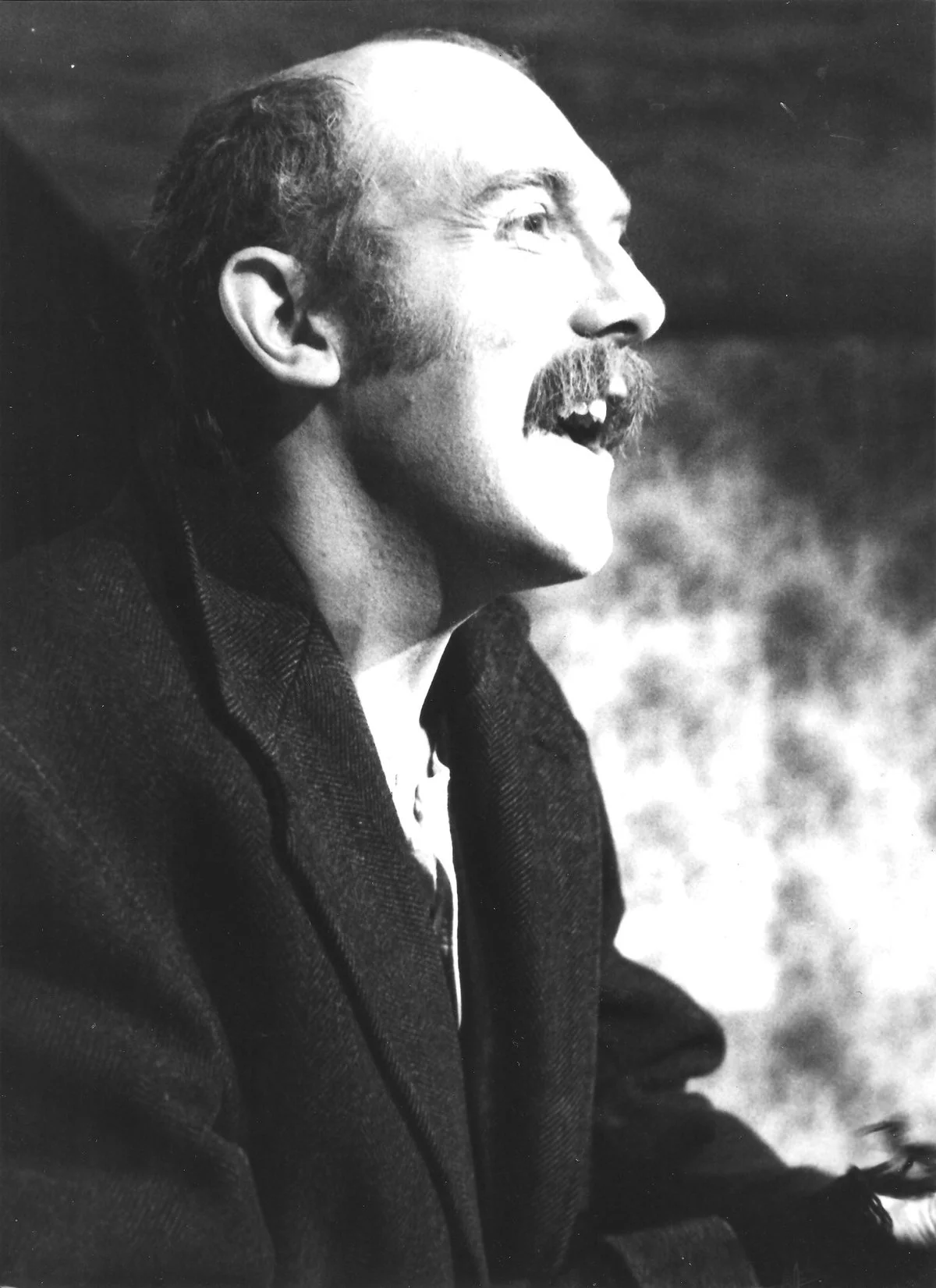
Me as Davies in The Caretaker. Directed by Jem Barnes. I even shaved my head for the part.
The Dance
The actor’s energy is what burns through the whole performance. The stored up resource that the words release out to the audience. Indeed it is the release of energy that carries the whole enterprise. This release manifests itself in different ways. I have seen actors who measure out their energy with quiet determination as much as with wild exuberance.
The gathering of energy and its measuring it out is the dance. The dancer centres their energy on the centre of their body. Just below their navel. This is where strong instinctive forces are centred. The dancer will tell you that everything pulls into this part of the body under extreme emotion. Cold, fear, anxiety pull inwards towards this point. Elbows and knees pull towards it. Head and hands loll back, unwanted for the moment. The back bends inwards protectively. But then with the explosion of energy everything cascades outwards. Strong positive energy drives the head upright. Limbs punch outwards. Stored energy is released. Breath is pushed outwards and the voice is strong and resonanant.
The concept of Physical Theatre is sometimes misunderstood by actors today. It gets confused with Dance Theatre. And, while dance and dramatic acting do have the same origin, for us here, we are talking about the way that the actor needs to anchor their performance deep in the physical centre of their being. and the physicality of natural, human gesture stems from that.
In this inward and outward movement is the breath of humanity. And as the strength courses through the actor, the audience responds. Feeling that breath themselves. It is a remarkable facility that within close proximity people will unconsciously align rhythms. With a baby sleeping on your chest you will automatically synchronise your breathing. People living closely together will naturally synchronise routines. And we feel disorientated by meeting someone whose bodily rhythms are so out of kilter with our own. Each audience will find it’s own rhythms of breath and release and the good actor will sense and tune into those rhythms. I like to think about it as surfing on a wave of audience reaction.
In this section I should also talk about pacing. This is very much to do with the ebb and flow of the words and actions. Speeding up here, slowing down there. Respecting the sense of the actions and thought processes so that sometimes you are almost clipping the heels of the other actors. Sometimes slowing to think. Sometimes pausing to let a cloud pass over the sun. I’ll deal with that in the part about the Director’s role later.
Humanity
It is the actor’s role to let the audience experience situations and emotions that they might not have come across before. The actor stands in for the audience and the audience can imagine how they would act in a similar situation. They see themselves as though from the outside. Perhaps we have all experienced that feeling where, when watching a harrowing item on the news, the sharp pang of unrequited emotion rises in the throat, almost strangling sound and causing tears to prickle the eyes. You need that physical awareness of emotion as any human being would. Some actors are particularly capable of reaching for the emotional heart of a line and can easily access the emotion that drives it. But they must also be aware of what they are doing lest the emotion swamps, not only the actual performance but, worse, themselves. Emotion and control of that emotion are required. And, whether you are portraying an historical figure, or a murderer, or a Russian Princess, it is the humanity of that portrayal that brings the audience to it.
When Colin Dexter spoke at John Thaw’s funeral he said that what Thaw bought to a character was…
“…Humanity. And that meant the capacity to be hurt. The capacity to be genuinely, visibly hurt by the world while continuing to move through it.”
So if there is one thing you can do to improve as an actor for the Burning Stage, it is to learn everything you can about human beings. Sit and watch as they pass to and fro in the street. Not just people you sympathise with but those others whose lives, at first, make no sense to you. Learn the psychology and philosophy and what makes human beings tick. Observe the choreography of the world. Fall in love with the people of the world.
Because acting is an expression of love.