The Burning Stage #3 A Shared Experience
Some Useful ideas to start with
A drama is the interplay of two or more characters shown through words and actions.
This interplay is usually represented as some conflict or problem that needs resolution.

The action on stage ensues because of a discrepency in power or status. I call that a Power Gradient. During the course of the Drama the characters can change where they are on the Power Gradient. The change is brought about either by the agency of the characters themselves or through the circumstances they find themselves in. Really, this is the essence of story-telling. I’ll come to that in a bit more detail when I talk about writing for the Burning Stage
Natural human empathy means the audience become immersed in the emotional to and fro of drama so, they too, feel some transformation in themselves. This is called catharsis. This is the whole point of the Drama. Thus, it is important that the audience can experience this empathy without being prodded into it. For me this requires the simplicity, directness and intimacy of The Burning Stage.
The Fiery Triangle

There are three elements reponsible for creating the Drama - The Eternal Triangle, if you like. Writer, actor, audience. They all share the responsibility for bringing this play to life and giving it meaning. Think of it like the Fire Triangle - Fuel, Heat, Oxygen. Without anyone of these, the fire dies. As a writer I must always bear in mind the living presence both of the actor and of the audience. I must respect their contributions to what I am trying to achieve. They are both present on my desktop as I am constructing my play as much as my pc and dictionary. My contribution as a playwright is only a third of the finished piece. I am not even there when the actor and the audience contribute their parts to the performance. The actor contributes their physical presence, their experience of the world which enables them to interpret what I have written. And they will have spent many hours delving into this in the rehearsal room. The audience brings their understanding and perception of what is happening at this actual moment and how they feel about it. Plays depend on process. Every performance will result from a different process. Different actors = different manifestations of character. Different audiences = different interpretations.
As a playwright I try and recreate a world in which the audience will suspend their disbelief in what they’re seeing for an hour or so and within that, their experience becomes totally real; exactly as if they were witnessing something that happened to them personally on their way here. And their experience will be quite different from the person in the next seat or at the next performance. They may have struggled in out of the rain and dumped their shopping on the front of the stage. During the performance They will be flicking their eyes from here to there. Taking in peripheral details like exit signs and someone coughing. But even if they’re concentrating properly, they may not necessarily be concentrating on the actor at the front of the stage or the one speaking. They may even be distracted for a moment by a noise from outside and may miss a whole chunk of exposition. But the human brain is a wonderful thing and it will try to make some sort of sense of what is going on even if that is quite at variance with what I originally intended. The words I write and which the actor speaks will resonate differently with every person. The crucial element is that what they see is immediate and ephemeral. There is no turning back the pages to check a clue to the puzzle There is no guidance by camera work or editing tricks. An audience member makes sense of what is in front of them. For an hour or so we all share a space and an experience, but the result will be different for us all. I have written about this elsewhere at length so I won’t go into it in too great detail. In short, I suggest that the experience of Drama is divided in three equal parts. The writer, the actor and the audience share an equal responsibility for the eventual outcome of the production. The writer devises and orders the ideas, the actor communicates to the audience and the audience contributes the attention and makes the decisions about how they will watch the piece. There is no power gradient here.
As the lights dim on the audience and brighten on the stage we experience a ritual that denotes a beginning. Our attention shifts to focus onto the matter in hand. We enter into the same dream world as the actors and allow our imaginations to run wild.
Suspension of Disbelief
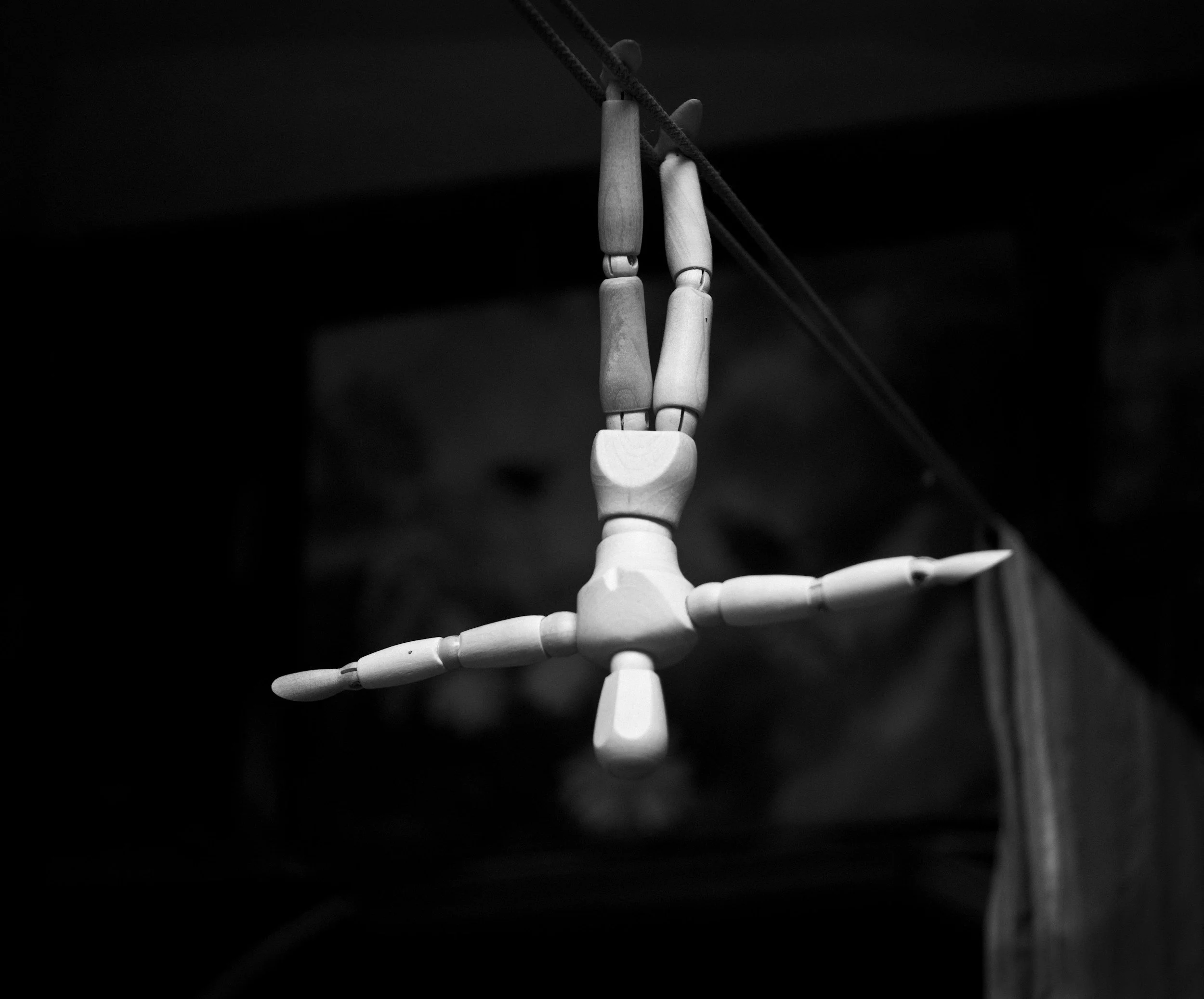
The process whereby actors and audiences are willingly transported to other imaginary realms is called Suspension of Disbelief. It is a natural phenomenon in human beings. The phrase was coined by the poet Samuel Taylor Coleridge in 1817 but has been undersood since the origins of drama. Shakespeare called it “imaginary puissance”.
There are deep neuropsychological reasons for how and why this phenomenon exists and there is a huge literature around this subject that I can’t precis here, so if you’re interested, I suggest you go to your favourite Chatbot and dive in there. Suffice it to say that Suspension of disbelief is something we make use of continually in the everyday world. It’s how we rehearse emotional responses to situations we haven’t met before. It enables us to put our current situation on hold mentally whilst we explore other possibilities. In a world of suspended disbelief we can
explore social situations,
imagine threats or opportunities,
and absorb cultural knowledge.
In short, it prevents us going mad with overload of data. We choose to accept what is real and frame decisions accordingly. In the world of politics and sociology we can willingly accept the premises of ideas without having to question what they are built on. It is a way of filtering the world we see around by accepting some parts of it without having to question every single item of our life. The idea of metaphor is a suspension of disbelief. If we say “That ship has sailed” to mean that an opportunity has passed, we do not believe that there is an actual ship even now disappearing over the horizon. But most of us will understand the image that is being used and we do not have to question the underlying structure of the thought that brings it into being.
Obviously, Suspension of Disbelief can be used for ill by bad people especially when they present conspiracies and fake science to us. These might seem absurdly obvious and entirely untrue to us as outsiders but for those enmeshed within them they cannot be seen past. But, for us who only wish well to the world, we can also harness its power to explain our story of human nature. However we do need to be aware that, as with the empathetic instinct, we are playing with some very potent psychological phenomena.
Suspension of Disbelief, however, relies on whatever is fantastical in our story being anchored in “human interest and a semblance of truth” as Coleridge puts it.
Nowadays there is some doubt about the use of the term in that, if an audience of a play were truly to suspend disbelief, they would rush onto the stage to prevent Duncan being murdered. J.R.R. Tolkien uses the term “Secondary Belief” which depends on a wholly consistent inner world which can be accepted as a reality in its own right. So we still retain the capacity to distinguish the Suspended reality from actuality. Even if we cannot restrain our desire to shout out “He’s behind you. With a dagger.”
Of course, it is also important to recognise the fact that the Actor has also to suspend their own disbelief. This throws up technical difficulties. The actor has, at once, to create and live within the character they are playing but also have an awareness of the actualities of the stage and the audience that surrounds it. This is where the directness and intimacy of the Burning Stage facilitates this psychological discontinuity. The shamen can work themselves into a frenzy of being; mixing up reality and belief into a whirl of dissonance. In the story of Hamlet, we see this effect when The Prince assumes an ‘Antic disposition’ and then becomes the very thing he is portrating. This goes further. There is an old story (told by Michael Frayn) that an actor portraying Hamlet actually had a mental breakdown whilst playing the disturbed Prince and came to believe that the actor playing the Ghost actually was his own Father in real life.
In truth, the idea of suspension of disbelief comes with the notion of a voluntary immersion in the fantasy. We choose to suspend our disbelief. The very act of immersion also allows us to know where the level of reality intersects with the story. We can surface from it at any moment like a diver reaching for the surface.
As I said before, we create a fantasy that is easy to plunge into and to remain there, undistracted by the elements of the outside world. But close enough to it to be able to maintain a rational awareness that there is another, Real world out there. Indeed we need this awareness so that comparisons with real life can be made whilst the drama is continuing.
However it is framed, though, Suspension of Disbelief has interesting implications for the Drama. It means that we need to construct an entirely plausible and internally consistent version of reality that does not jar the audience out of involvement. Do this well and and audience will buy into it and they will willingly follow to the end. It also means an audience does not need the aids of overwhelming lighting and sound. They do not need to be told what is going on. What may seem puzzling to an outsider will seem obvious to those closely involved. We are, in effect, playing an extendad game of “What-If?” “What if there was a castle in remote Scotland where an ambitious husband and wife live?” If you accept this premise then we’ll continue following the unwinding thread to its conclusion.
And once the premise is set, the audience enjoy measuring the events as they unfold against their own expectation. They enjoy contributing by their natural ability to work out what is going on for themselves. Constructing a new reality out of the bits and pieces they are given. Audiences can instinctively make sense of what they have before them, however spare it might seem. The Burning Stage is a manifestation of the old adage that “Less is more.” Audiences are naturally better equipped for watching drama than playwrights generally take them for and can otherwise survive without lots of flashes and bangs.
“As you read a book word by word and page by page, you participate in its creation, just as a cellist playing a Bach suite participates, note by note, in the creation, the coming-to-be, the existence, of the music. And, as you read and re-read, the book of course participates in the creation of you, your thoughts and feelings, the size and temper of your soul.”
― Ursula K. Le Guin
A New AudienceTheatre is in a bit of a Pic
None of this is new or startling but we all know that theatre has lost its way. For most people, if they can afford it at all, a trip to the theatre has become a once a year luxury. Young people find it difficult to find their way in to the art without huge amounts of money to back them.
So, how do we cope with the disappointment of an audience who come expecting a cast of thousands, glitter balls and extravagant special effects? The answer is, by the intensity of the performance and the demands on the imagination of the participants and watchers. And don’t forget, just because it’s intense it doesn’t mean it can’t have a grandeur and scope. We can still tackle the great dramas of the Greek Classical canon. Shakespeare, Comedies, farces all can be performed with this approach just as well as Becket or Genet. The main strength, though, is that The Burning Stage can be a local phenomenon. It works just as well in the upstairs room in a pub as in a studio theatre. A small space can provide the seed bed to grow a new audience. Of course, the limiting factor is, as always, money. But it can be done. And is being done. And, if we really believe in this approach, it is up to us to persuade funding bodies that this is a worthwhile way to distribute public funding
First, let’s get rid of all that reliance on stuff like extensive, expensive lighting and stage effects. Let’s narrow the focus of theatre down to concentrate on the little magic area which is the stage, right in the heart of the audience in which every bead of sweat and breath and nuance of voice is right there to be shared . Let’s dispense with the rigidity of structure and pre determined emotional responses that characterise the electronic media and commercial stage shows. This magic place does not recognise the difference of the actor, only their ability to show difference. It requires huge intensity of emotion to draw the audience in so that the audience becomes one with the actor